

Comprehensive OCD Assessments: Clear Answers for Hidden Struggles
Evidence-Informed OCD Assessments for Children, Youth, and Adults
You aren’t just “overthinking,” and you aren’t failing at therapy. Obsessive-Compulsive Disorder (OCD) is a complex, often invisible condition that requires a highly specific approach. At Level Up Wellness Group, we provide comprehensive, formal OCD assessments across the lifespan. Get the clarity you need to interrupt the cycle of distress, reduce uncertainty, and move forward with a targeted, effective treatment plan.
(Complimentary 20-Minute Virtual Meet & Greet)
The Problem
Turn Confusion into Clarity
When "Just Stop Worrying" Doesn't Work
If you are reading this, you or a loved one are likely exhausted.
For years, you may have been told that your symptoms are “just generalized anxiety,” “perfectionism,” or a “phase.” You may have tried traditional talk therapy, practiced deep breathing, or tried medications for anxiety, only to feel like you are still stuck in a loop of intrusive thoughts, endless reassurance-seeking, or exhausting mental review.
It is incredibly common to feel confused, ashamed, and isolated. OCD is frequently misunderstood and misdiagnosed in general healthcare settings, particularly when the compulsions are mental or “invisible.” In fact, many of our clients report that their OCD was previously misinterpreted as:
- Generalized Anxiety Disorder (GAD) or Social Anxiety
- Panic Disorder or Health Anxiety
- Depression
- Oppositional behaviour in children
- Personality traits (rather than treatable symptoms)
Without a formal, specialized assessment, many individuals spend years receiving care that might be helpful for general stress, but isn’t specific enough to interrupt the OCD cycle. A formal assessment is the critical first step to untangling the confusion.
(Complimentary 20-Minute Virtual Meet & Greet)
Accurate Identification & Practical Recommendations
At Level Up Wellness Group, we don’t just look for visible rituals like hand-washing or organizing. Our specialized Assessment Team is trained to identify the nuanced, often hidden ways OCD presents. Our goal is simple: provide accurate identification alongside practical recommendations that make sense in real life.
How We Work:
- Differential Diagnosis: We carefully untangle OCD from overlapping conditions like anxiety, panic symptoms, and depression, identifying when multiple concerns are present.
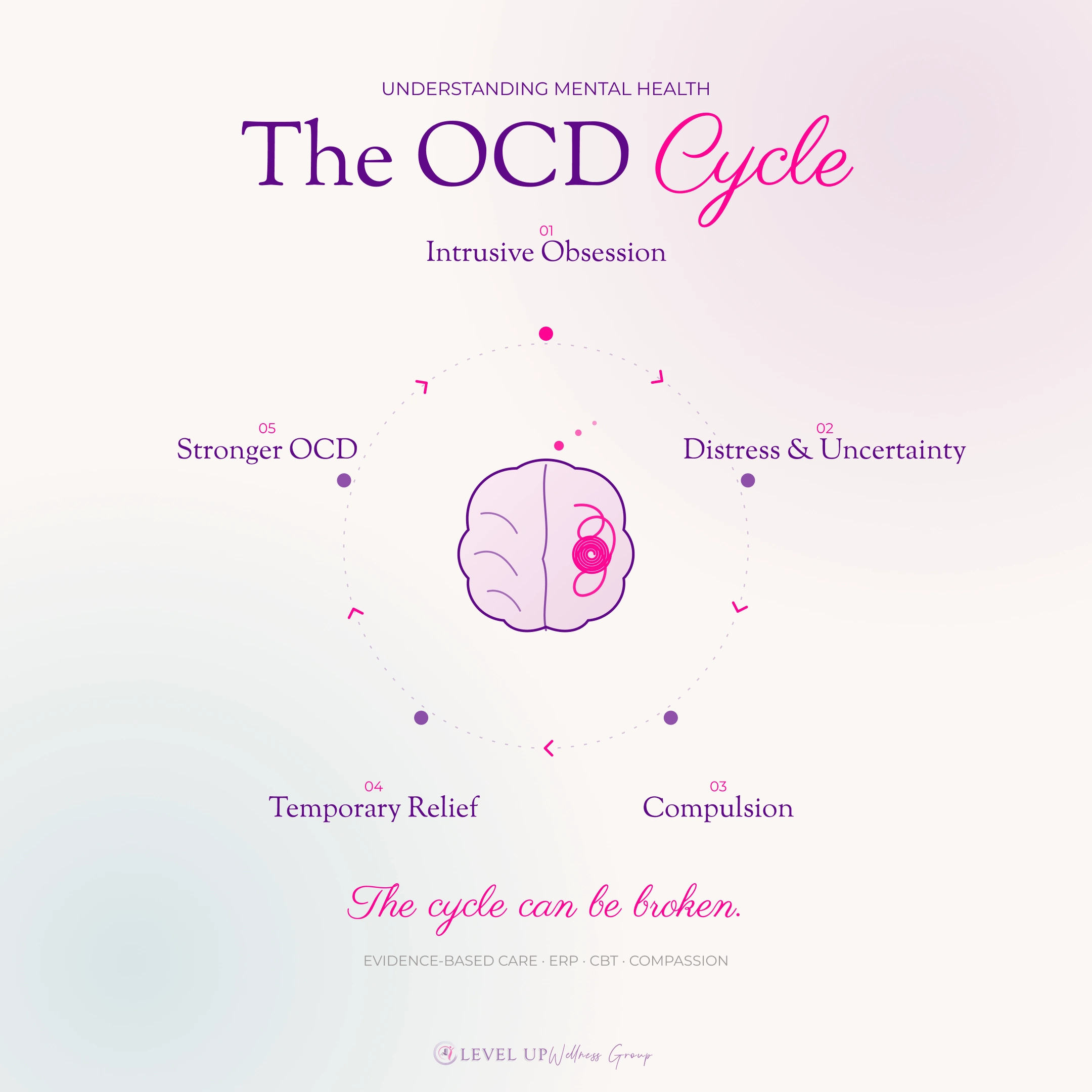
- Identifying the Cycle: We assess the core mechanism of OCD,how intrusive obsessions lead to distress, which triggers compulsions (visible or mental) for temporary relief.
- Assessing Family Accommodation: We evaluate how family members may be participating in or adjusting to rituals (“family accommodation”) to ensure your treatment plan includes strategies for the whole family.
- Evaluating Impact: We look at how symptoms affect school, work, confidence, and family dynamics. We measure the severity, the time consumed by symptoms, and the patterns of avoidance.
Medical Collaboration: When appropriate, our multidisciplinary team includes Nurse Practitioners who can provide medical consultation and medication support to complement your therapeutic plan.
(Complimentary 20-Minute Virtual Meet & Greet)
OCD-Informed | Speciality Trained
At Level Up Wellness Group, we are committed to working towards being an entirely OCD-Informed practice to ensure the highest standard of care for our clients. Beyond general mental health training, our specialized assessment team includes members that are OCD trained through advanced, evidence-based programs, including the International OCD Foundation (IOCDF).
This means we don’t treat OCD as a form of general anxiety. We operate with a core understanding of the nuanced distress cycle, ensuring our assessments and clinical recommendations are based on specialized, gold-standard protocols. Our ongoing commitment to being fully informed and trained is how we ensure you receive the precise care required to interrupt the OCD cycle.
(Complimentary 20-Minute Virtual Meet & Greet)
The Level Up Approach (Our Methodology)
A Personal Mission
Dr. Melody Morin
For Dr. Melody Morin, the founder and Clinical Director of Level Up Wellness Group, OCD assessment and care is deeply personal. As a highly trained psychologist with over a decade of specialized focus and advanced training through the International OCD Foundation (IOCDF), she leads our OCD Assessment Team with strict clinical rigor.
But she also brings the lived experience of a parent. Having navigated a fragmented healthcare system to support her own child through PANDAS/PANS and OCD, Dr. Melody understands the urgency and isolation families face. She has trained our team using a structured, compassionate model to ensure you are met with accurate answers, deep understanding, and meaningful next steps.
How OCD Shows Up at Every Age
OCD presents differently depending on your age and life stage. Our assessments are tailored to capture these unique developmental nuances.
Children
OCD in children can look very different from adult OCD. Children may feel frightened, confused, and struggle to articulate their intrusive thoughts.
What we look for: Increased reassurance-seeking (“Are you sure?”, “Did I do it right?”), sudden avoidance of everyday activities, severe meltdowns linked to transitions or uncertainty, checking behaviours, bedtime struggles, or “just right” fear-based rituals.
(Complimentary 20-Minute Virtual Meet & Greet)
Youth & Adolescents
Teens often experience OCD in ways that are highly distressing but completely hidden, avoiding disclosure due to embarrassment or fear.
What we look for: Internal mental rituals (silent compulsions), prolonged time spent “stuck” in routines, academic decline due to constant checking or mental review, isolation from relationships, and irritability or emotional shutdown.
(Complimentary 20-Minute Virtual Meet & Greet)
Adults
Adults are commonly misdiagnosed when their symptoms don’t match the media stereotype of a “neat freak.”
What we look for: Disturbing, taboo, or “out of character” intrusive thoughts, chronic doubt and difficulty feeling “sure,” mental review, reassurance-seeking that strains relationships, and severe distress often misinterpreted as perfectionism or general anxiety.
(Complimentary 20-Minute Virtual Meet & Greet)
Integrating Medication Support with Precision
Medication can be a critical component of an effective OCD treatment plan. However, just like therapy, general anxiety medications or protocols may not be the most effective approach for complex Obsessive-Compulsive Disorder.
At Level Up Wellness Group, our multidisciplinary team includes Nurse Practitioners who are committed to an OCD-Informed model of care.
Why It Works
- Guideline-Driven Prescribing: Our medical providers understand the unique neurobiological and clinical profile of OCD. They work from specialized, evidence-informed OCD guidelines when considering medication and supplements.
- Beyond General Anxiety: We recognize that treating OCD with protocols designed only for Generalized Anxiety Disorder (GAD) may be insufficient. Our focus is on targeted, precision care to decrease suffering by addressing the specific mechanisms of the OCD cycle.
- Integrated Approach: Your medical consultation will complement your therapeutic plan, ensuring a seamless, coordinated approach to your care
The Level Up Assessment Process
Your Roadmap to Clarity
A robust and accurate OCD assessment is a focused journey, not a single snapshot. We tailor the scheduling to your needs and energy, ensuring the process is thorough without being overwhelming.
Assessment Logistics
- Flexible Scheduling: The entire assessment can be completed in a few extended sessions or broken down into multiple 50-minute blocks, allowing you to move at a pace that supports your comfort and insurance needs. Time Commitment: Depending on the complexity of your symptoms and co-occurring concerns, a comprehensive and robust OCD assessment typically requires between 5 to 10 hours of direct clinical time.
- Outcome: Following the assessment, you will receive personalized recommendations and a clear roadmap for targeted treatment.
(Complimentary 20-Minute Virtual Meet & Greet)
Clinical Focus
Our specialized team utilizes gold-standard OCD assessment tools and clinical interviews to ensure a precise, differential diagnosis this includes the Yale-Brown Obsessive Complusive Scale (Y-BOCS), Family Accommodation Scale, thorough clinical interviews and other measures based on your presentation. We look beyond surface-level symptoms to fully understand your unique presentation:
- Mental Compulsions & Themes: We actively screen for hidden mental compulsions (often called “Pure O”) and thoroughly explore the unique themes of your OCD (e.g., harm, contamination, moral scrupulosity).
- Co-occurring Concerns: We assess for overlapping conditions such as depression and anxiety to ensure your final treatment plan addresses all contributing factors.
(Complimentary 20-Minute Virtual Meet & Greet)
Involvement for Recovery
For children, youth, or adults with significant support systems, parent and partner involvement is strongly recommended. Understanding the role of family accommodation and how loved ones may be unintentionally adjusting to rituals is essential to interrupt the OCD cycle and promote lasting recovery for the whole family.
(Complimentary 20-Minute Virtual Meet & Greet)
Myths, Reality, and the Family System
What OCD Really Is (And What It Isn't)
OCD can include many symptom themes, such as contamination fears, intrusive harm thoughts, unwanted taboo thoughts (sexual, religious, moral), Relationship OCD (ROCD), perfectionism, or the fear of causing harm through negligence.
OCD is not defined by the content of the thoughts - it is defined by the cycle of distress and compulsions.
Myth: "OCD is just being neat and organized."
Reality: OCD is driven by intense discomfort and intrusive thoughts, not a preference for cleanliness.
Myth: "If I know my thoughts are irrational, it shouldn't bother me."
Reality: OCD is not a logic problem; it is a distress and uncertainty cycle. You cannot simply “out-think” it.
Myth: "OCD always involves visible rituals."
Reality: Many compulsions are entirely hidden, such as mental reviewing, counting, or silently neutralizing “bad” thoughts.
Myth: "Reassurance helps OCD."
Reality: Reassurance may help briefly, but it often strengthens the OCD cycle over time.
Family Accommodation
OCD rarely affects only the individual—it impacts the entire household’s routines, parenting decisions, and relationships. “Family accommodation” occurs when loved ones participate in rituals, provide repeated reassurance, or adjust daily life to “keep the peace” and reduce the individual’s distress.
Accommodation is not a failure—it comes from love, protection, and exhaustion. However, over time, it unintentionally reinforces the OCD cycle. Our assessments evaluate family impact so that your treatment plan includes vital support and strategies for the whole family, not just the identified client.
Meet Our OCD Assessment Specialists
Experts in Evidence-Informed OCD Care
Our collaborative team of Registered Psychologists, Counsellors, and Medical Providers are specifically trained in the identification and management of OCD. Find the right fit for your journey below.
OCD Classification
Types of OCD
I can assure you that all these different types of OCD are just names, denominations, or tags you put into the theme of obsessions and compulsions; they don’t mean that if you have a different problem or a different struggle. What starts, augments, reinforces and maintains OCD is the same regardless the theme; so, more than boxing obsessions, focus on learning core skills that apply to all of them is key.
Dr. Zurita Ona
Perfectionist OCD or Just Right OCD
This term usually refers to obsessions about a sensation or feeling that is interpreted as “weird, uncomfortable, distressing, off feeling”, and because it’s so uncomfortable, sticky, and hard to let go, as obsessions are, a person engages in compulsions related to symmetry, ordering, arranging their physical environment, or any other form of compulsive behavior until it “feels right.”
Because of these organizing behaviors, this form of OCD is also knowing as perfectionistic OCD. A popular misconception is that people dealing with these types of obsessions or compulsive behaviors in general, they’re very organized, neat, and likes perfection, but this is an assumption that is far from what actually happens in a person’s shoes.
Some people with this form of obsessions, when triggered by fear, may engage in what it looks like “perfectionistic behaviors” like arranging their environment, as a compulsion, in a way that “feels right” to them and not necessarily in a symmetrical manner all the time (e.g. moving the wallet in oblique position to the person’ leg). In addition, to that, some of them may prefer to keep things organized, but that doesn’t mean everyone who has an obsession or any form of OCD will automatically inherit those preferences.
And just to make it crystal clear, the compulsions or organizing behaviors-are driven to avoid the discomfort that comes along with uncomfortable feelings and the obsession that “something is wrong and off.” The organizing compulsions are not necessarily to avoid that something bad or a catastrophic ending from happening-but with the purpose of neutralizing, getting rid of, or minimizing the distress that comes along. Lastly, when referring to this form of OCD, the term “just right” also includes mental compulsions characterize by a person repeating sayings, making lists, counting words, praying, or any other form of mental compulsions until they feel right.
Relationship OCD or ROCD
R-OCD covers obsessions related to relationships; while initially this term only included obsessions affecting romantic relationships. These days, the academic literature also reports case of R-OCD between parent-children, and even relationships with spiritual authorities in some cases.
While it’s natural for all of us to deliberate about the fit of a romantic relationship, the fit with a partner, whether our feelings for them are real or not, the degree of panic, fear, and anguish that comes with these reflections is considered a form of OCD; reflecting of life matters it’s one thing, but having obsessions about relationships that are hard to let go, that are more like sticky thoughts, and that when unsolved one cannot move forward with their day-to-day activities is extremely painful.
Current writings recognize Relationship OCD as having two variations relationship-centered and partner-focused (Doron, G. & Derby, D. 2017). In plain language, these variations can be seeing in three types of common obsessions and many variations or combination among them:
(1) Is this the right relationship for me? (e.g. am I just settling down? Would this relationship be a long-lasting one?
(2) Do I really love this person? (romantic partner, parent, child, religious figure)
(3) does this person really love me?
People struggling with this theme of obsessions can spend years not fully committing to a partner in a relationship, and it may even appear as if they have “commitment phobia;” but, they maybe struggling with intrusive thoughts about relationships. Frequent compulsions may include testing their feelings when spending time with their partner (e.g. am I in love, do I feel love?), searching for the Aha or warm feelings inside, checking their sense of attraction, their romantic memories, or comparing current feelings with feelings they had with different partners across relationship.
Common public compulsions are: asking for reassurance about being loved, asking others about if they observed cues that their partner loves them, discussing about the quality of the relationships with their partners. Avoidant behaviors may be: not saying “I love you to a partner,” not responding to compliments about the relationship, avoiding having intimate relationships with a romantic partner, and others.
Pure O, Pure OCD or Pure Obsessional
“Pure OCD” is a term that has created controversy among clinicians, researchers and OCD sufferers because as it’s written, somehow it conveys the message that a person dealing with Pure OCD doesn’t have either public compulsions or compulsions in general, and may have only “pure obsessions.”
Here is my take: there is no need to argue about this label but to it in context, as we have done with the other labels about different forms of OCD we have reviewing in this chart. If you look at the literature on OCD, most of it was focused on public compulsions that are visible to the eyes of everyone and while, there were some writings about people that have mental compulsions, no much was written about it. Who knows how many people got undiagnosed because of it and didn’t know they were suffering with OCD.
With the premise, let’s briefly clarify that pure OCD or mental OCD is a myth given that all OCD episodes include both, an obsession and compulsions and as you have read before, if a compulsion is private, then we call it mental compulsion.
The term of “pure OCD” can be triggered by all types of obsessions, from fears of getting contaminated, existential themes, doing things right and everything in between. The key characteristic is that the compulsions are private, no one sees them, and even the sufferer doesn’t know that is engaging in a mental compulsion, because all what they’re focus on is on getting rid of the distress that comes along with those wacky obsessions.
In the chapter, “the trilogy that makes your life miserable” there is a chart of the different form that mental compulsions have so you will read more about them there.
Just to give you a preview, some of the mental compulsions look very low key like saying sentences, repeating words or counting numbers, but they can also be very complex like replaying past scenarios over and over until they feel right because your brain is holding onto a memory that feels safe, right, and blocks the disturbing obsessions.
Sometimes, the clients I have worked with, they quickly engage in mental compulsions that gives them re-assurance, that are hard to catch for a person that is not familiar with OCD.
Contamination OCD
This is, perhaps, one of the most well know forms of OCD since it has been disseminated through social media quite often.
People with fears of contamination get hooked into the fear of “being contaminated” because of direct contact with different substances such as toxic chemicals, dirt, germs, garbage, sticky substances, or bodily fluids (saliva, semen, faces, etc.), or contact with objects that are contaminated by any of the contaminants.
Very common compulsive behaviors are handwashing, excessive long shower, wearing hand gloves, sanitizing different areas, changing clothing that has been exposed in the street environment before getting in contact with furniture in the house, asking others if it’s safe to go to a particular place or if a stain that a person stopped in is safe; or replaying the past triggering situation until a person.
Avoidant behaviors usually include avoiding contaminated places like hospitals, public bathrooms, people who have a particular illness, shaking hands of people that could potentially contaminate them, and so on.
Past literature use include within fears of contamination also fears about emotional contamination; however, the last couple of years, the theme of metaphysical OCD has captured these fears related to contamination obsessions.
Moral OCD, Religious OCD or Scrupulosity OCD
Scrupulosity OCD or Moral OCD speaks to obsessions related to the fear of intentionally or accidentally committing immoral acts, being an immoral person, saying or doing things wrong, or engaging in any form of behavior that goes against a person’s morals, standards, or religious beliefs.
The specifics of an obsession that is incongruent with a person’s religious beliefs varies from person to person given their religious background. For instance, within the Jewish community some examples of obsessions are fears of violating dietary restrictions, or disrespecting Shabath. For a person of a Christian background, some obsessions involve offending God, going to hell, or disrespecting religious authorities. (Huppert & Siev, 2010).
Most common compulsions with this form of OCD include excessive praying, asking for re-assurance, figuring out or replaying a religious practice, asking God for forgiveness, confessing sin, checking over and over their behaviors to see if they committed a sin, avoiding spiritual contamination, or avoiding spiritual services or figures that are triggering for them.
Unfortunately, individuals struggling with OCD related to this type of obsessions struggle distinguishing what’s a religious behavior from a compulsion to the fear of not following and living accordingly to their religious beliefs. In fact, a person may see a compulsion as a commendable behavior, even though is driven by fear that is debilitating and hard to let it go, as usually obsessions are characterized.
Existential OCD
This theme of obsessions involves philosophical, existential, and reflections about life issues that while seem natural, reflects that every person goes through at some point or another. When these thoughts are obsession they come along with extreme distress. It’s hard to let it go, and there is an ongoing search for resolution to these themes.
Common obsessions are about death, life after death, feeling love after death, making the best of life, whether the emotions are the right emotions in a given situation, immortality, life after death experiences, and others.
Compulsive behaviors are scanning memories in which experiences happen-replaying situations when a person fall love-discussing with others; dissecting past encounters when having a feeling to make sure it was the right feeling; discussing about these topics as a form of “figuring them out” and have the right response, searching online, reading philosophical books.
Sexual orientation OCD, HOCD, Gay OCD
This is another form of OCD that is usually misconstructed and underdiagnosed; common obsessions are about sexual orientation, infidelity, sexual deviations, and at times, sexual thoughts related to religious authority figures or religious figures. (Gordon, 2002).
These forms of obsessions have nothing to do with a person’s view of homosexuality, but with intrusive thoughts, worries, fears about feeling attracted or wanting to be with the opposite sex of what they have been usually attracted to; this applies for people of all gender orientations. For instance, a homosexual person could have intrusive thoughts about being straight and so on.
And just to make it crystal clear, a core difference between sexual orientation obsessions versus being confused about sexual orientation or having sexual fluidity is that obsessions are extremely upsetting, stressful, pop out of the blue, and are inconsistent with a person’s history of sexual preferences. Sexual obsessions are also different than sexual fantasies or horny thoughts, because the latter ones involve pleasure, fun, and are enjoyable.
People having sexual obsessions may have thoughts along the lines of “I notice I’m paying more attention to girls than guys, like I like checking them out, and checking how cute they are, is that because I’m gay?”
Sometimes people with this form of obsessions are terrified that somehow, they’re in denial of their real sexual orientation, and would entertain thoughts such as, “maybe I’m just scared about coming out; maybe one day I’ll wake up and I’ll have to come out of the closet.”
Compulsive behaviors may include checking whether a sufferer feels more attracted to people of a different sexual orientation than what they’re attracted to; checking their desires to have sexual contact with the other person, e.g. do I want to kiss her? Do I want to have sex with them?; testing their intentions at times when hanging out with others of a different sexual orientation; figuring out the physical sensations they experience, trying to find the meaning of having these thoughts; confessing about their thoughts about the opposite sexual orientation of theirs just to make the point that they’re not “that.”
Avoidant behaviors usually include minimizing contact with people who are triggering, watching TV shows or any social media related to people of the sexual orientation that is triggering for them.
People struggling with this theme sometimes gets hooked onto thinking along the lines of, “because I have those thoughts, means they’re important and that I want to do those things.”
Post Partum OCD
This class of obsessions include intrusive thoughts about harming the recent deliver babies, contaminating the baby with toxic products, or accidentally harming the baby. Some authors have also reported fears about doing something sexually inappropriate or emotionally contaminating the baby with bad energy or bad vibes.
It’s extremely distressing and panicky for a parent to experience and acknowledge these intrusive thoughts when they are expected to be happy and bubbly about becoming a parent; and because of this social pressure, therefore, there is much secrecy around this theme of obsessions.
While most of the literature has suggested that mothers are affected by post-partum obsessions, there is preliminary research that suggests that fathers experiencing this type of obsessions as well (Abramowitz, 2001 – XXXX).
Compulsions can be repetitive routine behaviors when for sleeping, checking that the blankets are not close to the kid’s face so the baby doesn’t died suffocating, multiple times checking that there are no other objects in the crib, holding a mirror to check if the baby is breathing, checking with others if the baby is okay, asking people to be with them when being with the baby, and so on.
Avoidant behaviors usually are avoiding being alone with the baby, changing the baby’s diapers, being around sharp objects, giving a bath to the baby oneself, holding the baby, walking while holding the baby, feeding the baby, and others.
Common Questions About OCD Assessments
Frequently Asked Questions (FAQ)
For a full list of questions and answers, see our FAQ page.
I've already been diagnosed with anxiety. Do I still need an OCD assessment?
Yes, if your current treatment isn’t working. OCD is frequently misdiagnosed as Generalized Anxiety Disorder. Standard talk therapy and coping strategies (like deep breathing or logic-based reassurance) can actually make OCD symptoms worse. An accurate assessment clarifies what is happening and ensures you receive the correct, specialized treatment, such as Exposure and Response Prevention (ERP).
I don't have any physical rituals (like tapping or washing). Can I still have OCD?
Absolutely. This is often referred to as “Pure O” (Pure Obsessional), though the compulsions are still happening they are just internal. Mental rituals like silently reviewing past conversations, counting, neutralizing “bad” thoughts with “good” thoughts, or chronic reassurance-seeking are all very common compulsions.
What happens after the assessment is complete?
After your assessment, you will receive a comprehensive report and clear recommendations. This may include an OCD-specific therapy plan (like ERP), strategies to safely reduce family accommodation, school or workplace accommodations, treatment for co-occurring anxiety or depression, and referrals for medical support through our Nurse Practitioner team if appropriate.
Are these assessments covered by my insurance?
Level Up Wellness Group does not direct-bill insurance companies for formal, flat-fee assessments. However, at the conclusion of your assessment, you will be provided with a detailed, itemized receipt that you can submit to your extended health benefits provider for potential reimbursement. We also offer third-party financing through Medicard for clients who require flexible payment arrangements.
Clarity is the First Step to Calm
If you suspect OCD is driving your distress, or if you’ve been treated for anxiety for years without meaningful improvement, a formal assessment can be the turning point. You do not have to navigate this uncertainty alone.
(Complimentary 20-Minute Virtual Meet & Greet)
