

Comprehensive Trauma Therapy & PTSD Support
Trauma leaves a physical mark; it is carried within the body just as much as it is held in the mind. Whether you are navigating the lasting effects of childhood neglect, Intimate Partner Violence (IPV), coercive control, or complex PTSD, you don’t have to carry the weight alone.
At Level Up Wellness Group in Beaumont, we offer a sanctuary of safety and validation. Through specialized EMDR and trauma-focused therapy, we are here to help you heal from the inside out.
Your Safety is Our Priority
If you are currently in a controlling or high-conflict environment, please take these steps to protect your privacy:
- Incognito Browsing: View this site in a Private or Incognito window to prevent it from appearing in your history.
- Quick Exit: Use the floating QUICK EXIT button on the right to immediately redirect to a neutral site if you are interrupted.
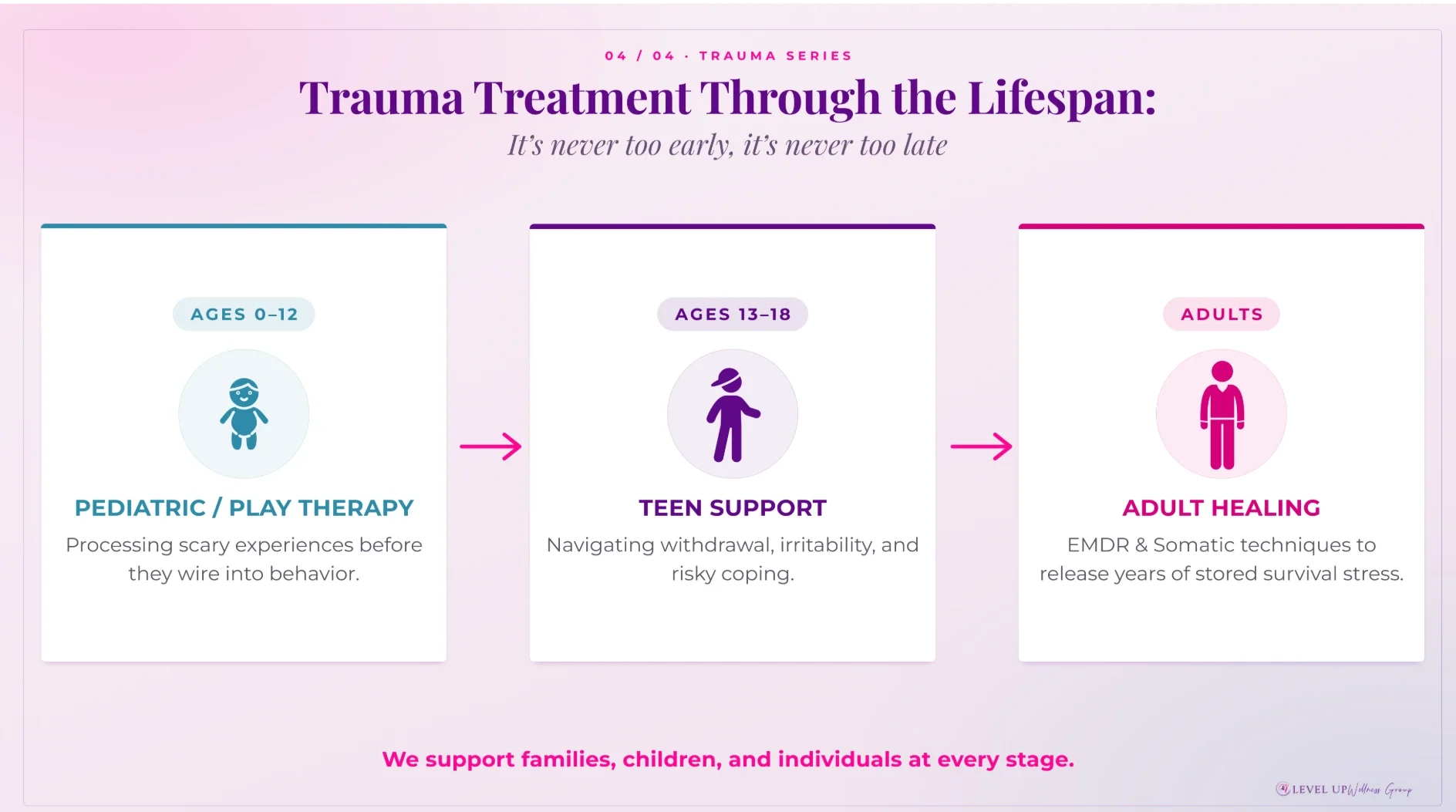
Trauma Across the Lifespan: It's More Than You Think
Many people avoid seeking help because they feel their experience “wasn’t bad enough.” But trauma is not defined by the event itself, it is defined by how your nervous system responded to it.
Understanding the Spectrum of Trauma
Trauma is defined by your internal response to an experience, not the event itself.
70%
of adults experience at least one traumatic event in their lifetime.
80%
of communication between body and brain travels up from the nervous system. This is why “just talking” often isn’t enough.
84-90%
of single-trauma victims no longer have PTSD symptoms after only three sessions of EMDR.
Common Forms of Trauma We Treat
Acute Trauma
Complex Trauma (C-PTSD)
Coercive Control & IPV
Vicarious Trauma
Specialized care for first responders and healthcare workers who witness the suffering of others daily.
Invisible Harm: Specialized Support for Coercive Control & Intimate Partner Violence (IPV)
Trauma doesn’t always leave a physical bruise. If you feel monitored, isolated, or constantly “confused” by your partner’s reality, you may be experiencing Coercive Control: a strategic pattern of emotional abuse used to strip away your autonomy. If you feel like you are “walking on eggshells,” you aren’t imagining it. Your nervous system is responding to a real threat.
You are not alone. 1 in 3 women will experience IPV, and in 99% of those cases, financial control is used to keep them stuck. We offer discreet support to help you reclaim your independence.
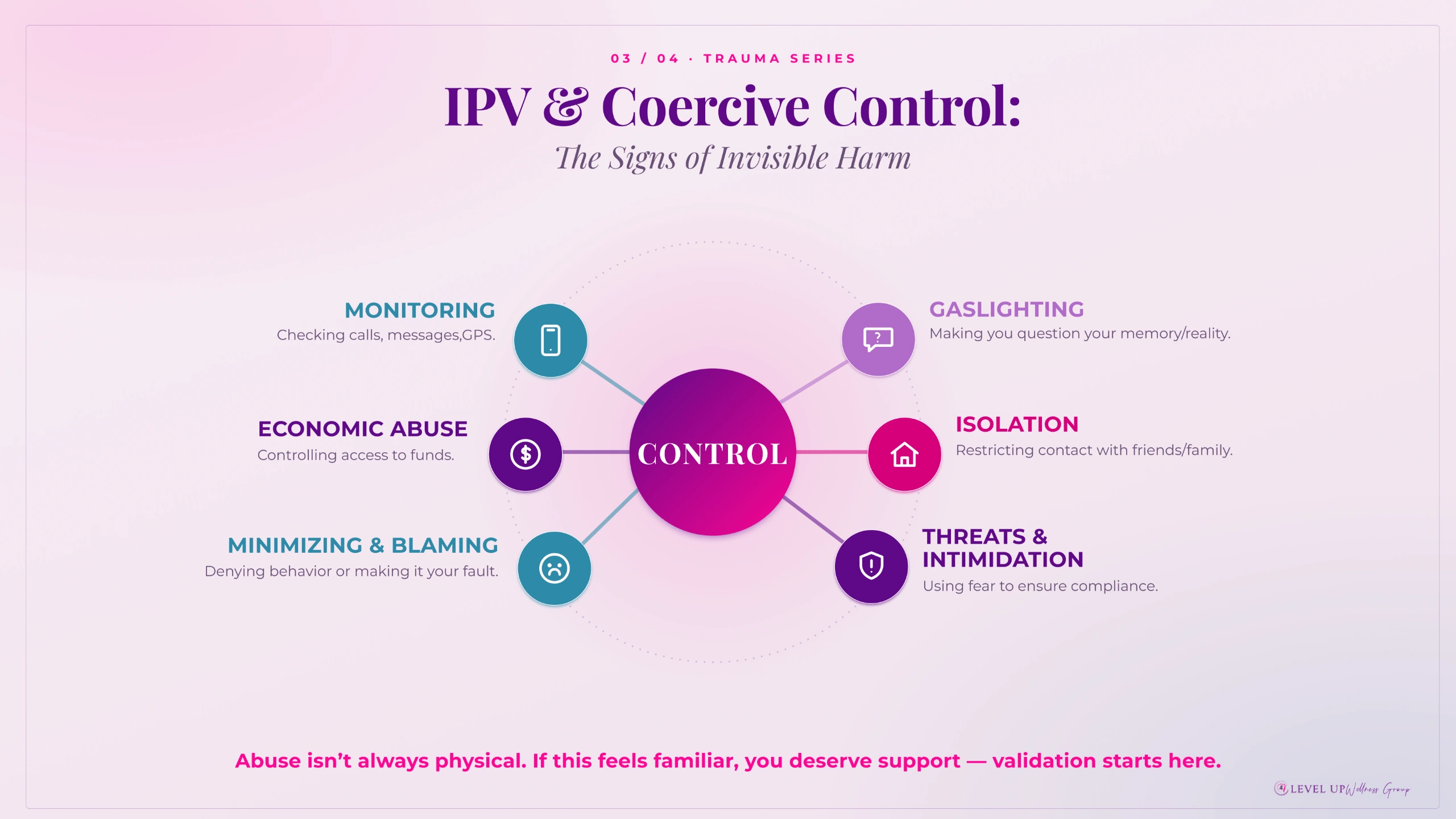
Are You Experiencing "Invisible" Abuse?
Beyond the signs above, we help clients identify and heal from these deeper survival mechanisms:
- The Fawn Response: Feeling forced to people-please your partner just to keep the peace; an inability to say "no" as a survival mechanism.
- Trauma Bonding: Understanding why it is so difficult to leave, even when you know the relationship is harmful.
- Hyper-vigilance: "Scanning" your partner's mood or footsteps to stay safe.
Your Body and Mind Deserve to Feel Safe
Trauma can shatter your sense of safety, leaving you feeling disconnected or stuck on high alert long after the danger has passed. We offer a profoundly safe, validating space to process your experiences at a pace that feels right to you.

When the Past Keeps Interrupting Your Present
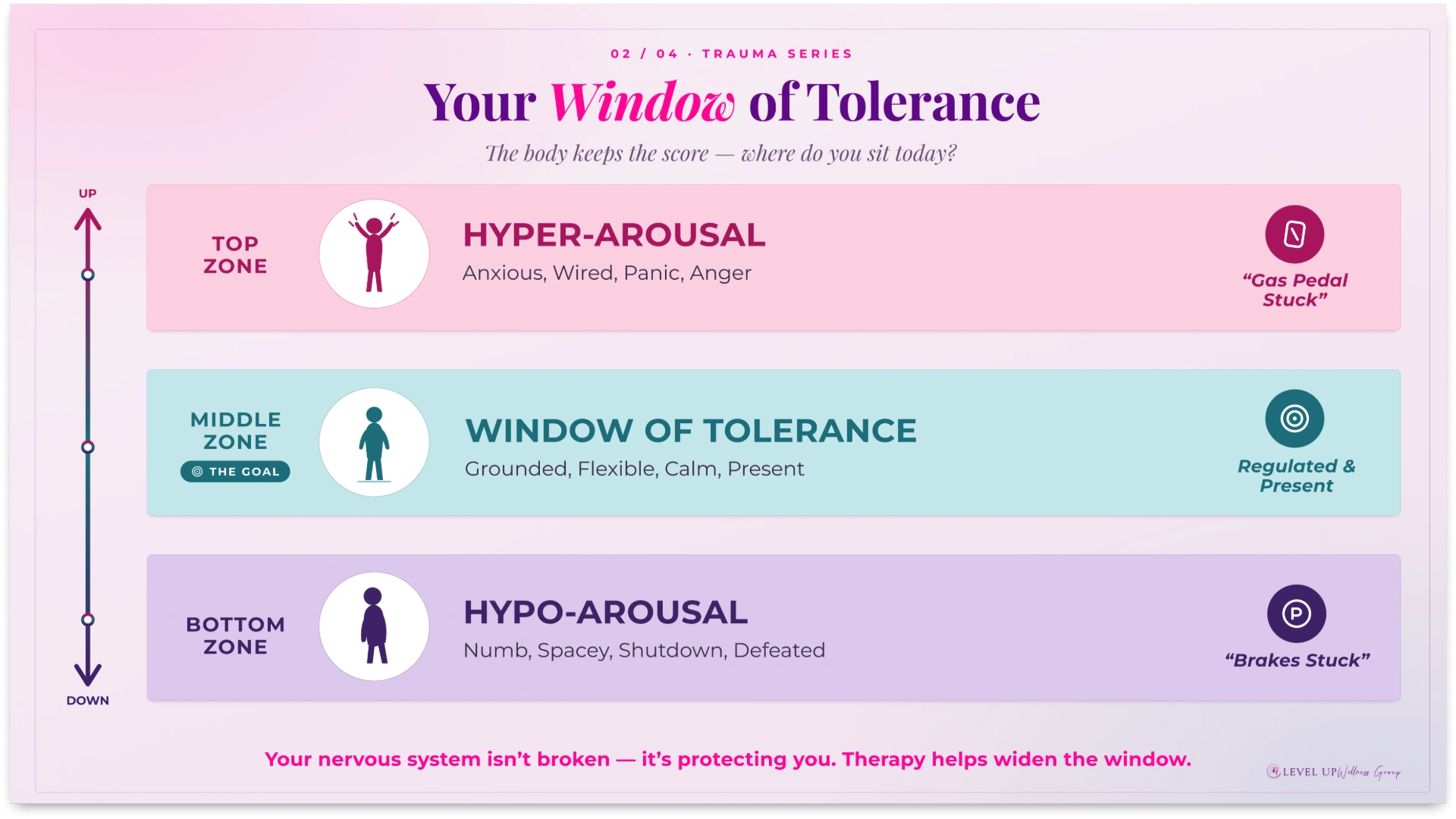
You are not “broken,” and you are not overreacting. This is your nervous system’s incredibly intelligent way of trying to protect you. You may notice these symptoms even if you don’t “feel” emotional:
- Hyper-Vigilance: Constantly scanning the room or "bracing" for bad news.
- Dissociation: Feeling like you are watching your life from behind a glass wall.
- Exaggerated Startle: Jumping at loud noises or sudden movements.
- The "Body Budget" Deficit: Chronic fatigue, migraines, or digestive issues doctors can't quite explain.
The Science of the "Stuck" Brain: Why You Can't Just "Get Over It"
When you experience trauma, your brain shifts out of “learning mode” into “survival mode.” Understanding this biology is the first step toward healing.
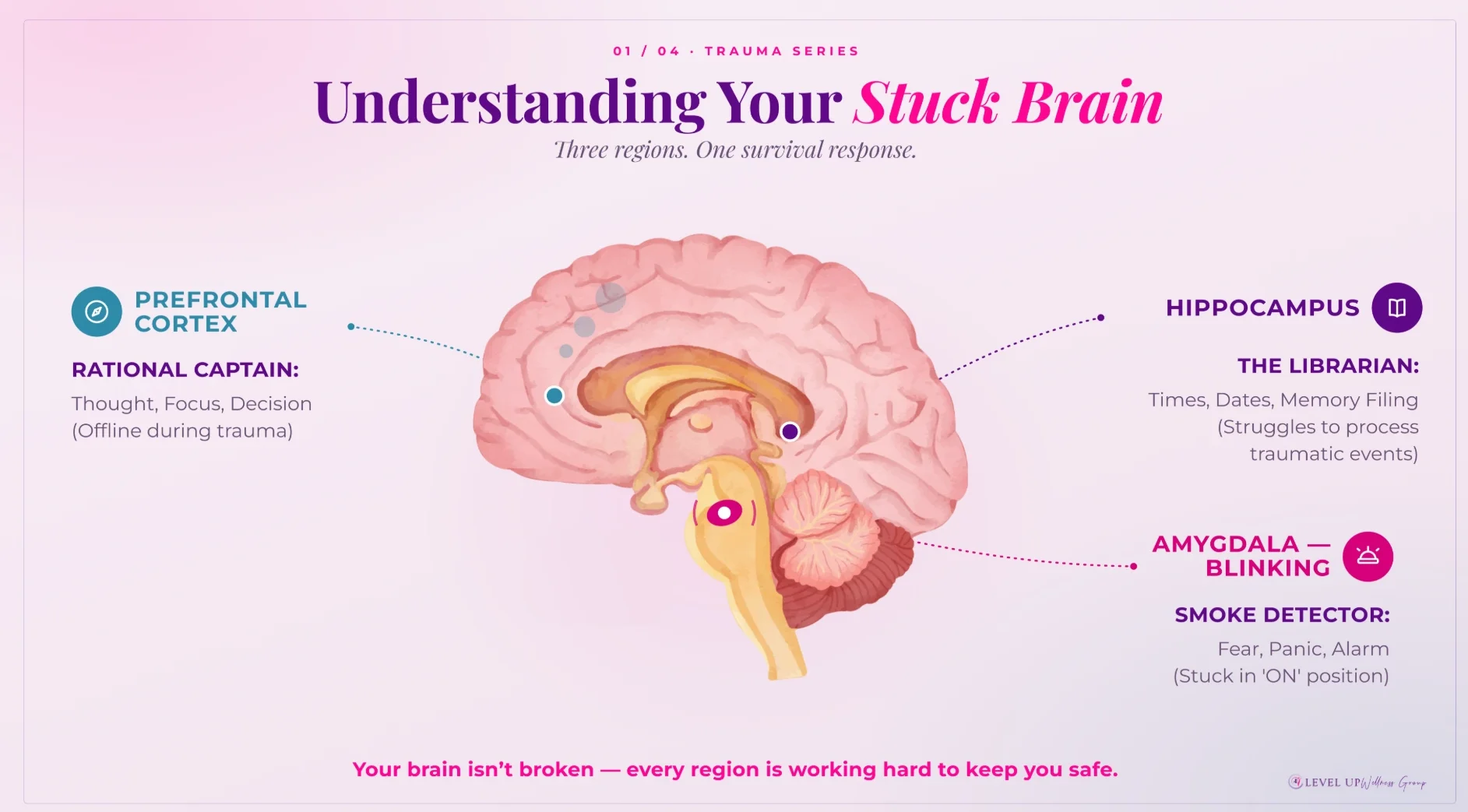
The Level Up Approach: Talk therapy focuses on the Captain. But trauma lives in the Smoke Detector. Our methods, like EMDR and Somatic Processing, work “bottom-up” to quiet the alarm and help the Librarian file memories where they belong: in the past.
Why You Feel "Stuck": Understanding Your Window of Tolerance
A Safe Space for Your Nervous System
A “deeply safe environment” isn’t just a phrase, it is a physical requirement for healing. Our Beaumont clinic is designed to soothe the senses and provide the “felt safety” necessary for trauma processing.
- Weighted Blankets & Lap Pads: Deep pressure input that naturally calms the nervous system.
- EMDR Technology: Modern light bars and tactile "tappers" to facilitate bilateral stimulation comfortably.
- Sensory-Informed Spaces: Adjustable lighting, white noise machines, and discreet private parking to reduce environmental triggers.

Science Meets Compassion: Our Approach to Trauma
We focus on how trauma is stored in your nervous system, helping your brain and body safely process memories so they no longer control your present.
EMDR
Somatic Regulation
Body-based techniques to tune into physical sensations and safely release stored tension, exiting “fight or flight.”
CBT
Play Therapy

Healing Through Play: Pediatric Trauma Support
Children don’t process trauma by sitting on a couch. They process through their natural language: Play. Early intervention matters; childhood trauma increases the risk of adult lung disease by 2.4x.
- Safely resolve scary or confusing experiences through guided play.
- Develop "felt safety" in their bodies to reduce meltdowns and anxiety.
- Trauma vs. ADHD: Many children are misdiagnosed with ADHD when actually experiencing a "Hyper-arousal" trauma response. We help differentiate and treat the root cause.
Debunking Trauma Myths: Frequently Asked Questions
I will have to retell every detail of my trauma for therapy to work.
You absolutely do not. With modalities like EMDR, we can process traumatic memories without you ever having to re-live or describe the graphic details aloud. Your safety, comfort, and pacing are our top priorities.
Am I "traumatized enough" for this?
Trauma isn’t a competition. If an experience is causing you ongoing distress, anxiety, or impacting your daily life, it is valid. We treat both “Big T” traumas and “Little t” traumas like chronic invalidation or workplace stress.
Time heals all wounds. If I just wait, I'll get over it.
Time alone does not heal trauma. Traumatic memories are often “stuck” in the amygdala and don’t move into the past. Without targeted processing like EMDR, trauma can remain “active” in the body for decades.
What is the difference between PTSD and Complex PTSD?
Standard PTSD usually stems from a single traumatic event; C-PTSD results from repeated, long-term trauma where escape was difficult. C-PTSD often involves difficulty controlling emotions, persistent shame, and challenges maintaining relationships.
Is it trauma or just ADHD?
There is significant overlap (difficulty concentrating, restlessness, impulsivity). A trauma response is often Hyper-arousal. We specialize in differential diagnosis, and our nurse practitioner who specializes in trauma and ADHD can help determine a diagnosis.
If they didn't hit me, it wasn't "real" abuse.
Coercive Control and psychological abuse can be just as damaging, sometimes more enduring than physical violence. The constant “high alert” of living with a controlling partner causes neurological changes and long-term PTSD symptoms.
Can I come to therapy if I am still in an abusive relationship?
Yes. You do not need to leave your relationship to seek support. Our first priority is Safety Planning and Stabilization, in a confidential, non-judgmental space, at your own pace.
Will my partner find out I am in therapy?
Confidentiality is the cornerstone of our practice. Unless there is an immediate risk of harm to yourself or a child, your sessions are private. For those in controlling environments, we can discuss discreet ways to manage appointments.
Is this covered by my health benefits?
Yes. Sessions provided by our Registered Psychologists, Provisional Psychologists, and Clinical Social Workers are typically covered by most extended health benefit plans. We offer courtesy direct billing for many major insurers.
Our Integrated Approach
Healing from trauma often requires more than just talk therapy. Our mental health therapists consult collaboratively to support your whole self. When appropriate, we can seamlessly connect you with our Nurse Practitioner to explore medical support for the physiological impacts of severe stress.
Why Healing Can't Wait: The Impact of Chronic Survival Mode
Unprocessed trauma doesn’t disappear; it “leaks” into your physical health and your future. Research, including the ACE Study, shows that chronic stress can lead to:
Physical Toll
Increased risk of chronic pain, migraines, and digestive disorders (the Gut-Brain axis).
Relational Toll
Mental Toll
The good news: Your brain is neuroplastic. With the right support, you can re-wire these responses and reclaim your sense of self.
Meet Our Trauma Specialists
Our collaborative team holds advanced, specialized training in trauma processing, complex PTSD, and nervous system regulation across the lifespan.
What Your Healing Journey Looks Like
03
You Deserve to Feel at Home in Your Own Body
You don’t have to carry the weight of the past forever. Reach out today, and let’s start the journey toward healing, together.
Need Help Right Now?
If you are in immediate danger, please call 911. For 24/7 confidential support in Alberta, you can also call:
